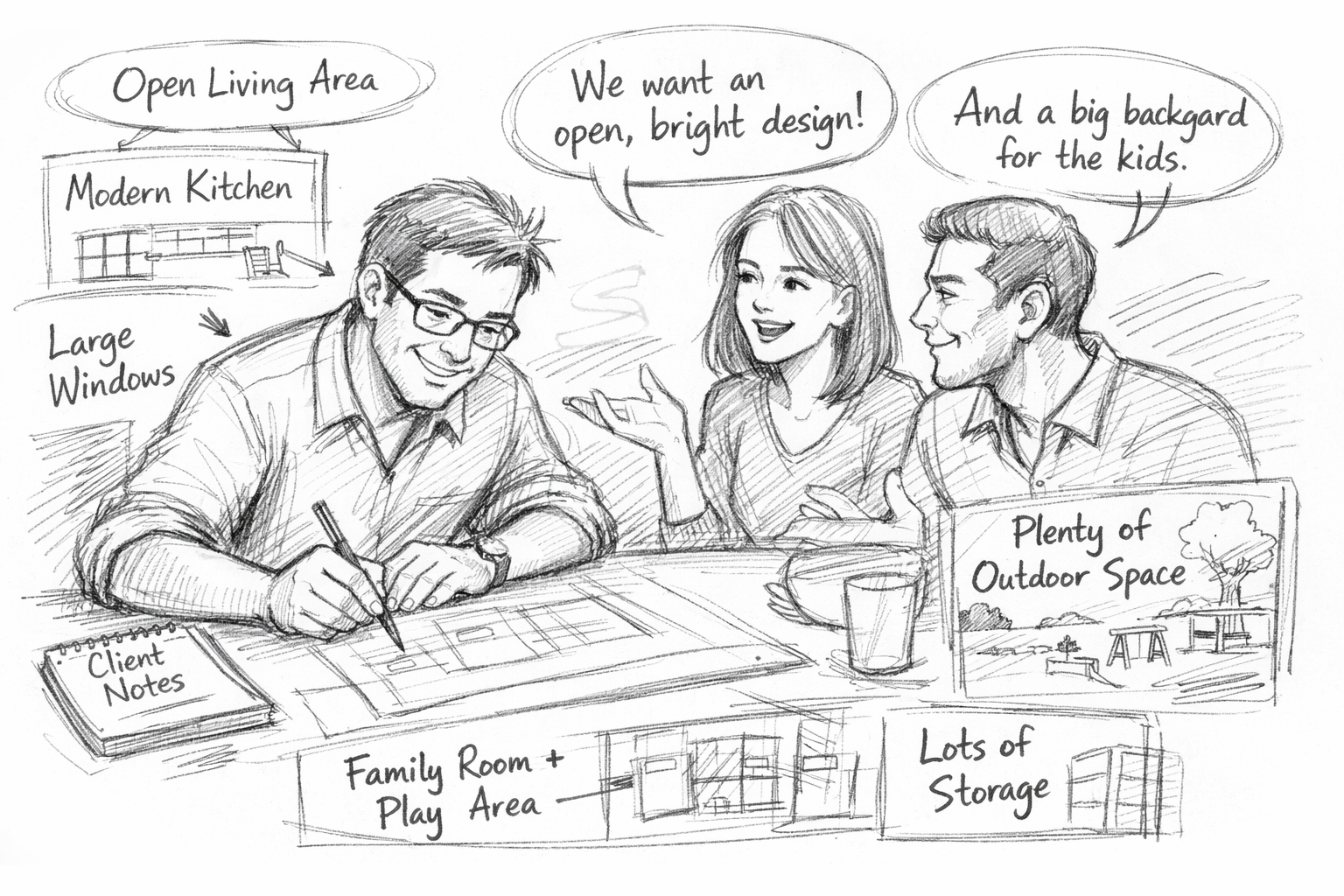
Why Clients Don’t Actually Know What They Want
(And That’s Okay)
Decoding Client Design Brief
The language of the client
Most clients don’t come to an architect with clarity. They come with excitement, anxiety, Pinterest boards, and a deep attachment to what already feels familiar.
And that’s completely human.
People don’t just live in houses. They live in habits. Over time, a home becomes a comfort zone. You know where the switches are without looking. You open certain windows instinctively. Your body remembers the kitchen layout better than your mind ever will. So when clients say they want something new, they often mean visually new but functionally familiar.
You’ll hear things like: “I want a modern home, but similar to what we already have.” “We’re open to smart systems, but we’ll mostly use manual switches.” “This layout looks great, but can we keep the kitchen exactly like our old one?”
This isn’t resistance to design. It’s uncertainty about adaptation. Clients aren’t always sure they’ll appreciate new layouts, new technologies, or unfamiliar systems once the novelty wears off. They worry whether these changes will genuinely improve daily life or just complicate it.
In some of my experience with our clients: – A client asks for an open plan home, then requests sliding partitions everywhere because they’re used to quiet, enclosed rooms. – Someone wants full home automation but insists every light also have a traditional switch, just in case. – A family redesigns their house but wants the sink, stove, and storage arranged exactly like their old kitchen because cooking already works that way for them.
These aren’t contradictions. They’re emotional safety nets. I believe as architects the role isn’t to shock clients with innovation, but to gently expand their comfort zone. Keep what works, improve what doesn’t, and introduce new ideas in a way that feels natural. Because clarity isn’t the starting point of good design. It’s the outcome. And when a client finally says “It feels familiar, but better,” that’s when you know the design has truly succeeded.
This website uses cookies to ensure you get the best experience on our website.